
Modal Shift: Myth or Reality? The Commitment of GRUBER Logistics
The topic of the so-called “modal shift” is a highly controversial subject among transport systems and policy experts.
On the one hand, there is a clear and determined policy actively pursuing modal shift, which involves transitioning from less sustainable transport modes, such as road transport, to more sustainable ones (such as rail). Both the European Union and individual Member States have established ambitious targets in this regard, such as doubling rail freight transport by 2050 (Source).
To achieve this goal, numerous national incentives stemming from EU targets aim to promote the increase of rail transport. The Italian Ferrobonus 2023 – 2026 is an example, as is the Spanish Railway Eco-incentive.
However, on the other hand, there are experts who argue that the concept of “modal shift” is more myth than reality.
While it is true that rail transport has recorded growth in recent years, it is also true that this growth is mainly attributed to the overall increase in transported volumes. Rail transport remains a fundamental component of sustainable logistics, but it is not yet dominant across the European landscape.
Figure 01: Evolution of road-rail combined transport 1990/2022 (Source: UIRR)
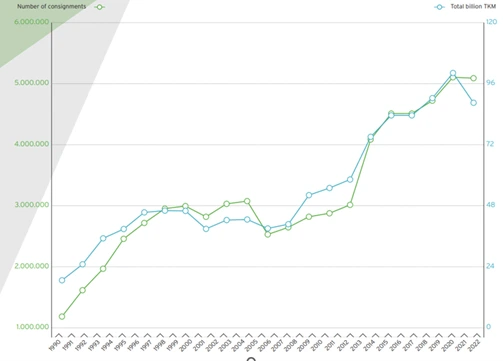
The percentage of goods transported by rail has remained relatively unchanged over the years. This suggests that there is not necessarily a shift toward more sustainable transport modes at the expense of less sustainable ones; rather, there is a parallel increase in both. For rail transport to become truly competitive, modern infrastructure, interoperability, and reliable services along major European corridors are essential.
Despite this debate, GRUBER Logistics strongly believes in modal shift. Whenever possible, GRUBER Logistics implements reliable rail freight solutions that are more cost-effective for customers and environmentally sustainable.
An example of this commitment is the recent expansion of the service connecting Verona to Leipzig, which has effectively doubled the available transport slots. In the face of prevailing challenges in European intermodal flows, marked by rising prices and declining volumes, there has been a steady increase in demand for intermodal services along the Brenner route. As a result, GRUBER Logistics can now boast a daily service with revitalized capacity along this crucial transport corridor.
This commitment is part of a broader strategy that leverages multimodal and intermodal systems as a tangible response to sustainability demands in freight transport.