
GRUBER Logistics participates in autonomous truck testing project in Hamburg
The city of Hamburg is set to become one of the first testing grounds for autonomous heavy goods vehicle technology in Europe. The four-year, EU-cofunded MODI project aims to accelerate the rollout of connected, cooperative and automated mobility (CCAM) solutions to significantly improve logistics chains.
This year, 34 organizations from 8 countries began testing and validating the implementation of automated solutions.
GRUBER Logistics is leading this process of collecting data relevant to real-world logistics operations. During a baseline test this autumn in the Port of Hamburg area, a GRUBER Logistics truck equipped with numerous external devices digitally scanned the urban route, collecting data on the truck’s interactions with its surrounding environment while driving.
The journey also provided insights into whether and to what extent the physical and digital infrastructure along the route is suitable for highly automated driving. The in-depth analysis of these data now serves as a starting point for further optimization within the pilot project.
The GRUBER Logistics truck examined in detail, for instance, where and how traffic flow on existing infrastructure can be improved, both within the port area itself and around motorway access and exit points. The measuring devices also identified potential hazard spots for “vulnerable road users”, such as pedestrians and cyclists, so that they can be eliminated, for example through infrastructural measures. Mobile network quality and coverage were also measured during the reference period. A good nationwide mobile network is essential for real-time data exchange between vehicles and infrastructure. Finally, the highly automated truck also analyzed the application of intelligent transport systems for autonomous freight transport operations. Some of these intelligent transport systems are already being tested in Hamburg. They operate on the basis of so-called V2X or “vehicle-to-everything” technology. This involves a vehicle networking with any device that it may influence or be influenced by, such as other vehicles, traffic lights, or roadworks.
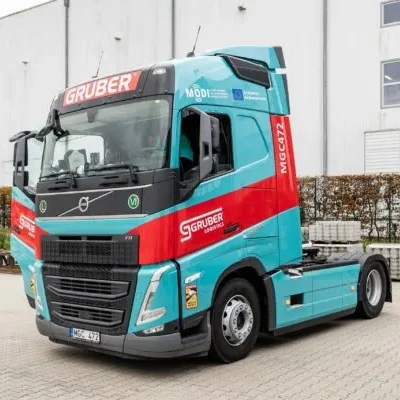
A further step is now planned for 2024, when GRUBER Logistics will drive a flagship automated truck from Oslo to Rotterdam to expand data collection under cross-border conditions.
The MODI project aims to demonstrate the advantages of networked and autonomous mobility and highlight its benefits for efficient and cost-effective logistics. To this end, project partners are also addressing regulatory and infrastructural challenges along the logistics corridor from Rotterdam to Oslo, with a stop in Hamburg. The pilot project is EU-funded and is a collaboration between industrial and public partners. Participants include New Mobility Solutions Hamburg, GRUBER Logistics, BASt, Volvo, DAF, and the Free and Hanseatic City of Hamburg.
Insights into the German use case:
To sum up, we can already say: “It’s complicated”. Since Hamburg is a major hub for freight transport in Europe and worldwide, road traffic on the test route leading into and out of the port is correspondingly heavy. Route planning is repeatedly made more difficult by obstacles such as road closures or traffic jams. Gaps in GNSS (Global Navigation Satellite System) and mobile network coverage in the urban environment are also possible. In simple terms, this means there are still a few challenges to overcome on the road to automated and connected mobility.
GRUBER Logistics is proud to play its part in the successful implementation of the MODI pilot project.
Stay up to date with us! Here we will keep you informed about the latest project developments and present the results in words and images once completed. Join us on a fascinating journey into the future of autonomous mobility.
To find out more, visit the MODI blog where the article on the reference test conducted in Hamburg was published.