
Who are the MTOs really?
Generally speaking, the term ‘multimodality’ is used (perhaps incorrectly) as a synonym for ‘intermodality’. It is not widely used in purely operational and commercial contexts; instead, it appears to be predominantly used in descriptions of transport policy. The same applies to the resulting designation of MTO operators.
One definition of an MTO is that provided by the Freight Leaders Council: “A Multimodal Transport Operator is a professional entity that organises and manages, both nationally and internationally, either at its own commercial risk or in partnership with other MTOs, a bulk transport service. Within the field of combined transport, this operator may organise a ‘company train’ where the link is dedicated to a specific client, or – as is the case in the vast majority of instances – provide an ‘open access’ service. In the latter case, all MTOs may, subject to a combination of terms and conditions, purchase train space either by contracting for a dedicated train space (loading slot) or through occasional bookings. In summary, from a market perspective, demand for combined or multimodal transport – where there are more than two modes of transport – can be met by a wide range of professional providers, depending on specific service requirements. These providers often offer a comprehensive and extensive range of services.”
It would therefore appear, according to this definition, that MTOs are primarily providers of intermodal rail services, with which other MTOs (which are themselves providers of other rail services) interact by purchasing specific slots from them and marketing them, in a rather collaborative manner.
However, the FLC also adds that “the number of organisations seeking to act as multimodal transport operators is generally and steadily on the rise. Shipowners, driven by the growth of containerised transport, have been joined by freight forwarders, rail carriers and, increasingly today, transport operators and 3PL or 4PL logistics providers. The latter are significantly renewing their fleets, shifting investment from the purchase of traction vehicles to that of transport units (swap bodies and/or crane-loadable semi-trailers)”.
And it is essentially this meaning that we intend to attribute to MTOs: operators who, on behalf of their client manufacturers, organise ‘door-to-door’ transport, from the point of origin to the final destination, using intermodal transport.
All of the above shows us that the transport sector – particularly as a result of its intermodal nature – is increasingly made up of roles that are difficult to define clearly using unambiguous terms, and that often overlap – at least partially – in terms of their duties. It is our task to untangle this knot as much as possible. In practical terms, therefore, it may be useful to distinguish between two types of MTO:
- Traditional MTOs, who are ‘aware’ of this designation and use it to describe their business: they are predominantly ‘providers’ of rail services for intermodal transport (mainly containers);
- ‘De facto’ MTOs, which do not commonly use this term but which coordinate and are responsible for the entire intermodal transport operation from the point of origin to the final destination; they are ‘purchasers’ of different modes of transport.
Finally, a question naturally arises: how does an MTO, in this latter sense, differ from a traditional freight forwarder? Primarily in the specific use of intermodal transport, but not only that; there is also a difference in liability. As CONFETRA specifies, “the difference between the services provided by an MTO and those of a traditional freight forwarder lies, first and foremost, in the different legal liability towards the client. The freight forwarder’s obligation is to follow the principal’s instructions, acting in the principal’s best interests when selecting carriers. The carriers alone, and not the freight forwarder, remain liable for damage to the goods, and it is against them that the principal must seek redress directly. With the expansion of freight volumes, the proliferation of delivery points, the increasing pressure to meet scheduled times, and the growing number of sub-carriers in each transport chain, cargo owners are increasingly seeking a single point of responsibility capable of meeting the mobility requirements of their goods. It is from this demand that the role of the MTO has emerged”.
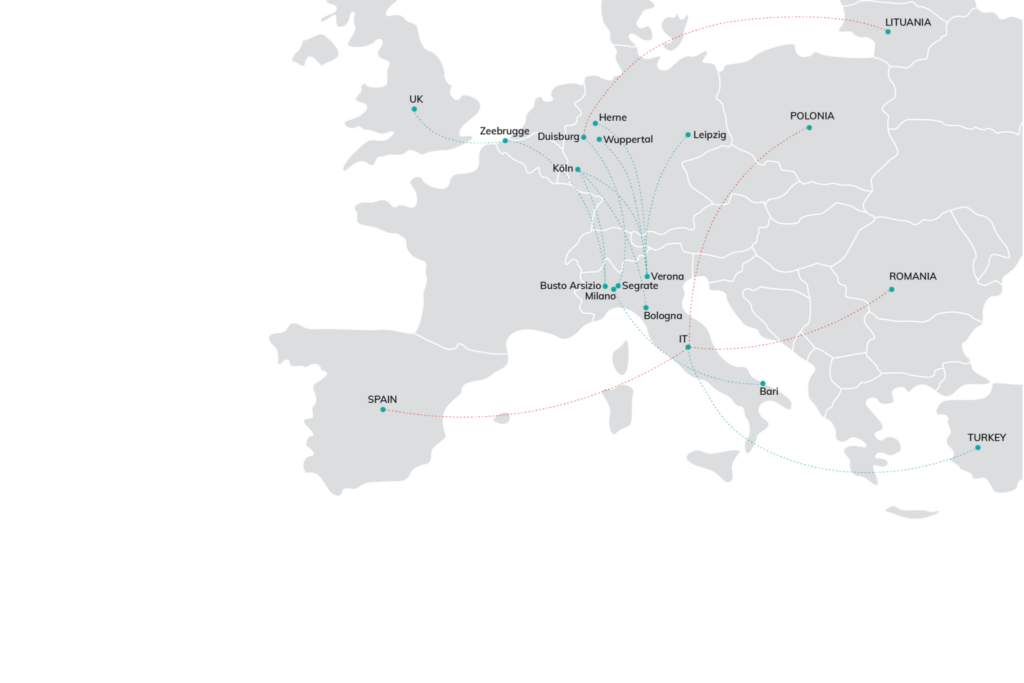
At Gruber Logistics, we firmly believe in multimodal transport. Intermodal rail transport currently accounts for 32 per cent of the full loads handled by the company. In addition to the benefits this mode offers for shipments – such as the ability to carry loads of up to 44 tonnes rather than 40 – there are also significant environmental benefits: CO₂ emissions are estimated to be reduced by up to 70 per cent.