
Will we set aside the Mercator projection?
The reference to the Mercator projection is no coincidence: by its nature, this cartographic representation tends to distort polar regions, magnifying them and making their actual proportions and distances harder to read. Yet, these very regions are gaining increasing relevance today. Looking at the Arctic with greater precision—including conceptual precision—means starting to view it no longer as a periphery, but as an actual transit area, gaining a better understanding of its actual distances and, consequently, the potential speed of the routes passing through it.
Until a few years ago, the Arctic Route—and specifically the so-called Northern Sea Route—was a topic for only a few specialists: academics, geopolitical analysts, or particularly visionary operators. It was discussed as a remote possibility, tied more to future scenarios than to real-world application in global transport.
To recap: this is a maritime route from Asia to Europe that crosses the Arctic Ocean predominantly along the Russian coastline, rendered increasingly accessible by the melting of sea ice caused by global warming, which is reducing summer ice cover. In this sense, it can be viewed as a potential alternative to the traditional Asia–Europe route via the Suez Canal, of which the Mediterranean represents a central component along this global trade corridor.
During the COVID-19 pandemic, the topic resurfaced with greater momentum. The vulnerabilities of global supply chains, combined with broader reflections on long-term geopolitical dynamics, brought the focus back to alternative routes. However, even then, the Arctic Route was often approached with caution, if not a degree of skepticism.
Today, something seems to have changed.
A tangible signal: the route is no longer just theoretical
The recent transit (October 2025) of a Chinese container ship along the Arctic route, completed in about twenty days, represents a tangible signal. We are not yet talking about massive traffic or large volumes—this is a preliminary path, charted by vessels of modest size compared to major intercontinental flows—yet structural transformations often originate from precisely such signals.
The question is no longer “if” the Arctic route is navigable, but “to what extent” and “in what timeframe” it can become a viable alternative.
The key advantage: time
From a logistics perspective, the main element of interest is the reduction in transit times. Current estimates indicate that the Arctic route could reduce sailing times between Asia and Europe by up to 50% (in the most favorable scenarios) compared to traditional routes via the Suez Canal, which are also currently exposed to congestion risks, geopolitical instability, and potential disruptions.
A reduction of this magnitude, if made stable and predictable, would have significant implications: optimization of vessel turnaround cycles, reduction in operating costs, and greater flexibility in supply chains.
However, it is crucial to emphasize that these advantages currently remain subject to critical factors: seasonality, weather conditions, limited infrastructure, and the need for technical support (such as icebreakers).
Mediterranean concerns
The Arctic Route is not yet an established solution. Rather, it represents an opportunity in an embryonic stage, which must navigate a range of operational, economic, and geopolitical uncertainties.
At the same time, another significant phenomenon can be observed: in recent years, several Mediterranean logistics players have been exploring alternative routes between Asia and Europe, particularly originating from the Indian subcontinent and the Middle East. This trend clearly points to a widespread desire for the diversification of logistics corridors, also aiming to reduce reliance on traditional chokepoints.
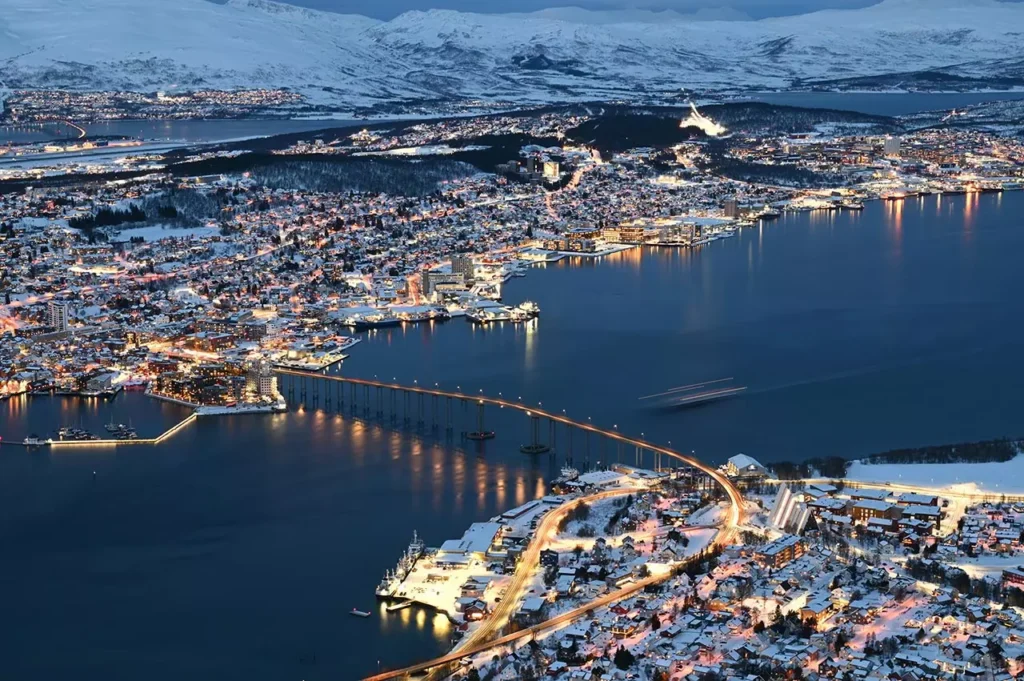
At the same time, the geopolitical dimension of the Arctic Route is rapidly consolidating. Russia, for example, is not limiting itself to declarations of intent, but is investing significantly along the Northern Sea Route, particularly in strategic ports such as Murmansk and Sabetta, with the aim of strengthening its economic positioning and control over the corridor. In parallel, China is developing the so-called “Polar Silk Road”, progressively integrating the Arctic into its global trade architecture. The United States is also showing growing strategic interest in Greenland, recognizing its geographic value in relation to new routes and its role in both trade and security. Together, these dynamics confirm that the Arctic is no longer a peripheral space, but an area of growing global competition.
In this context, the Arctic Route emerges as one of the potential variables in a system undergoing transformation.
A challenge (also) for the Mediterranean
It is inevitable that the emergence of a shorter route between Asia and Europe may raise questions regarding the future of the Mediterranean as a central hub for global traffic.
In some circles, this outlook is already seen through a competitive lens. However, it is probably premature to speak of a genuine systemic alternative: current volumes and operational conditions do not yet allow for a significant shift in freight flows.
Furthermore, it should be noted that the Mediterranean is not merely a transit corridor linked to the Suez Canal, but also a complex network of intra-Mediterranean traffic: regional trade, port-to-port connections, and distribution toward the European hinterland. These are dynamics that, at least in the short term, cannot be directly replaced by an Arctic route.
However, there is also a broader and, in some respects, contradictory dimension: while climate change remains a topic of debate and occasionally causes delays in political and economic decision-making, the very same global players are already capitalizing on some of its most evident consequences. The Arctic Route exists precisely due to the melting of polar ice, and rather than prompting a unified response focused on sustainability, it is fueling new competition for infrastructure, control, and influence. This tension between caution, opportunism, and strategic positioning is central to understanding the real dynamics driving the route’s development.
In any case, this is a clear signal that invites reflection.
Gruber Logistics’ perspective
At Gruber Logistics, we follow this evolution with great interest, without ideological stances or preconceived concerns.
We are an operator deeply rooted in the Mediterranean, and for this very reason, we consider it essential to understand in advance—or at least in parallel—the dynamics that could redefine global logistics balances.
Today, the Arctic Route represents an opportunity to monitor, a phenomenon to analyze, and a potential transformative factor for the international logistics system.
The path has been charted. It is still narrow, but visible.
Conclusions: observe, understand, anticipate
We are not yet facing a revolution, but certainly a shift in the making.
The history of logistics teaches us that major transformations often begin with weak signals that gradually become more pronounced. The Arctic Route could be one of these signals.
For industry operators, the real challenge is not choosing today whether to believe in it or not, but developing the ability to interpret these phenomena clearly, preparing for scenarios that, until recently, seemed far off.
We have already begun looking in that direction.
Find out more about Gruber Logistics’ air and ocean freight services.