
On-road testing in Hamburg urban traffic with automated trucks
In the spring of this year, two major on-road tests dedicated to heavy transport automation were successfully completed in Hamburg’s urban and motorway traffic as part of the European MODI project. In May, the project partners – GRUBER Logistics, DAF Trucks, Volvo Trucks, New Mobility Solutions, and BAST (Federal Highway Research Institute) – with the support of the City of Hamburg, tested two key use cases: merging autonomous trucks into motorway traffic and effectively detecting vulnerable road users in urban environments.
MODI is a European innovation project involving 36 partners from industry and research. With a total budget of around €28 million, the initiative aims to demonstrate the effectiveness of autonomous heavy transport along a real logistics corridor spanning five European countries. In addition to technological aspects, the project places particular emphasis on safety when integrating with existing infrastructure, environmental considerations, and regulatory frameworks.
“The growing shortage of drivers forces us to rethink the entire industry. It is essential to deploy these professionals where their contribution is truly strategic – for simpler and repetitive tasks, technology already provides viable solutions. Autonomous driving features and infrastructure technologies enhance safety not only for our drivers, but for all road users, including pedestrians,” commented Martin Gruber, CEO of GRUBER Logistics, contributing the logistics partner’s perspective to the project.
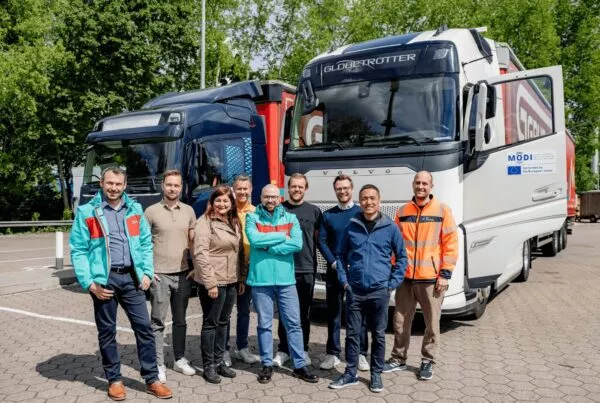
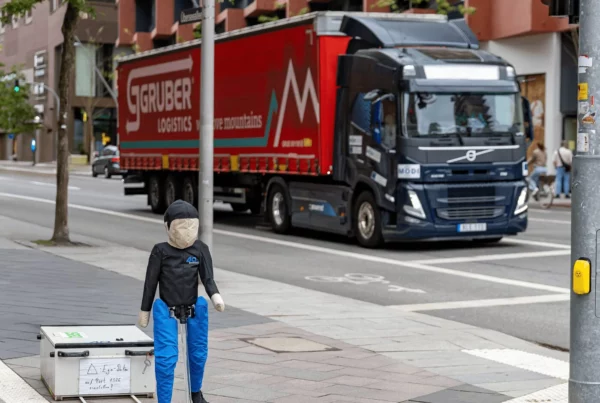
Thanks to close collaboration with local authorities and Hamburg’s traffic managers, the tests were conducted directly on public roads and under real traffic conditions – a vital prerequisite for the practical development of autonomous driving features. For example, in tests carried out in early May, automated lane-change maneuvers were successfully executed on a public motorway. Through the “Cooperative Merging” feature developed by Volvo, the vehicles involved were able to exchange real-time data with each other and with smart IT interfaces installed at construction sites, safely navigating purpose-built obstacles: from merging into moving traffic to negotiating roadwork zones.
Integration with urban infrastructure – so-called “smart roads” – was also tested. At one of Hamburg’s main traffic hubs, an innovative detection system capable of identifying vulnerable road users, such as pedestrians and cyclists, up to a distance of 300 meters was deployed. The movements of these users were analyzed and transmitted in real time to approaching trucks, compensating for the limitations of their on-board sensors. To realistically simulate critical blind-spot situations, crash-test dummies representing children were also used. This approach aims to guarantee an additional level of safety.
In parallel, the project partners also tested the cooperative use of traffic light data. Thanks to “time-to-green” information, trucks were able to adjust their speed in advance to cross intersections without stopping. At the same time, the infrastructure responded dynamically to traffic volumes: traffic light phases were flexibly adjusted according to the vehicles’ estimated arrival times. “This bidirectional exchange between vehicle and infrastructure had a significant impact on optimizing traffic flow, avoiding unnecessary braking and tangibly contributing to reduced fuel consumption and emissions,” explains Tobias Brzoskowski, Managing Director of New Mobility Solutions.