

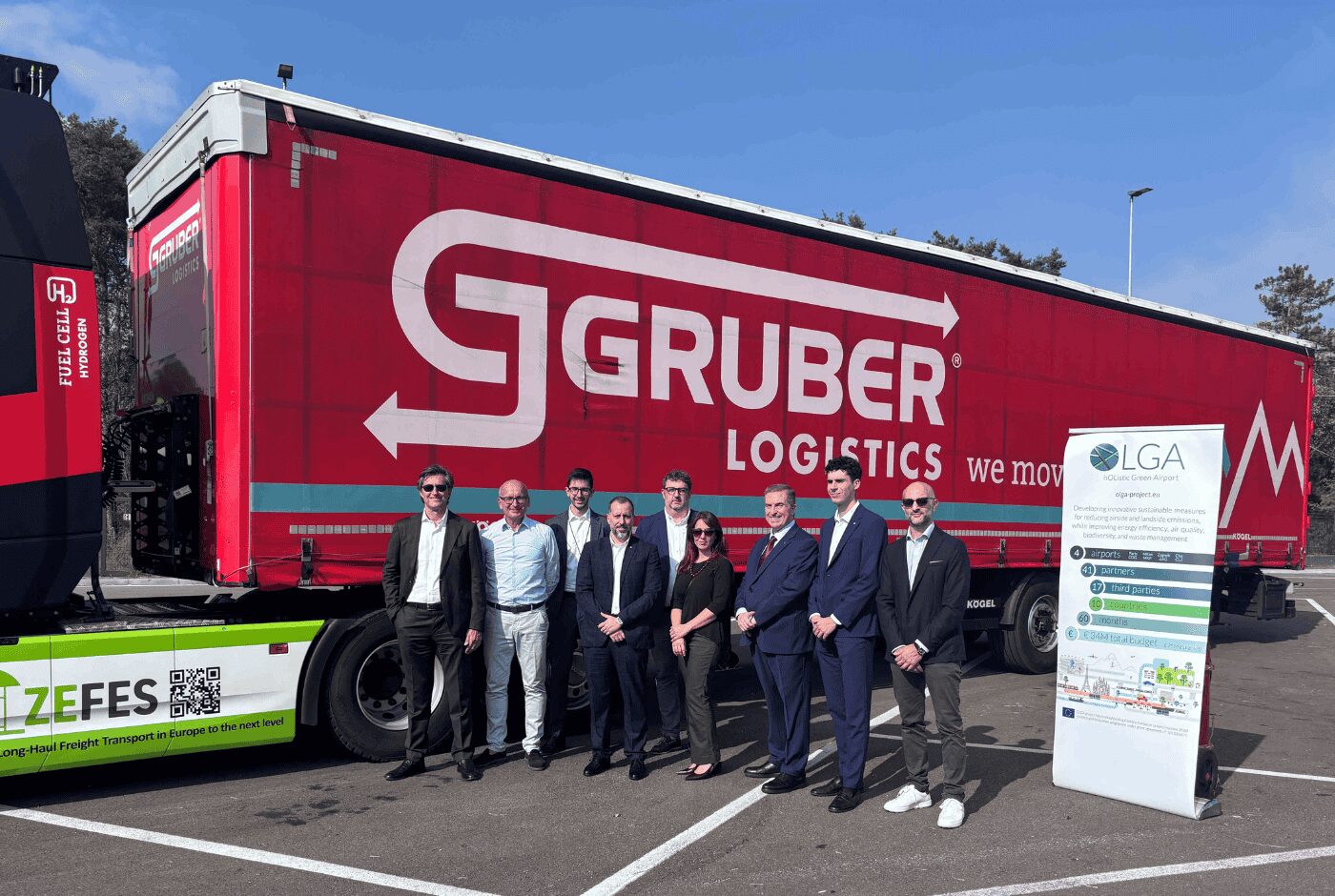
 Auer / Milan-Malpensa – At the end of September 2026, Milan’s main airport marked a milestone on the path towards greater sustainability in transport logistics. At the so-called Milan Malpensa Cargo City, a hydrogen fuel cell vehicle operated by GRUBER Logistics was deployed for the first time for demonstration purposes in freight transport for cargo handling companies.
This test drive, conducted at the beginning of autumn, is part of the European ZEFES project, which aims to advance research into the decarbonisation of freight transport through targeted pilot projects and to accelerate its implementation in the future. Airport transport logistics, with its tight schedules, controlled access points and substantial coordination requirements between the various stakeholders across the supply chain, provides a challenging and therefore particularly informative operating environment for testing new propulsion technologies.
Since spring this year, logistics service provider GRUBER Logistics has been using Scania’s hydrogen fuel cell electric vehicle (FCEV | Fuel Cell Electric Vehicle) to gather insights from various test runs for potential future applications in different operating environments. The Scania 40R FCEV, operating under the GRUBER Logistics banner, is generally deployed on long-distance routes. Equipped with a 700-bar hydrogen tank system, it has already covered 800 kilometres on a single journey at full load and under realistic operating conditions.
“The vehicle’s versatility was also demonstrated during this premiere at Milan Airport, where the truck had to complete short but demanding routes serving the air freight logistics operations. Being able to carry out these operations on a regular basis using ‘green’ hydrogen in the near future would represent a significant step towards decarbonising this environment,” explains Andrea Condotta, Director Public Affairs, Innovation & Sustainability at GRUBER Logistics.
“The truck also benefits from two different refuelling options. On the one hand, it can be charged at an electric charging station; on the other, it can be refuelled with hydrogen at different pressure levels. This makes it possible to cover distances that a truck powered exclusively by a battery could not achieve.”
The results of the demonstration held on 25 September 2026 at Milan Malpensa Cargo City will enable the various stakeholders involved, from the truck manufacturer to the logistics provider, to further develop their concepts for hydrogen-powered transport. SEA Milan Airports, operator of Milan’s main airport, and its technology partner Edison Next are planning to establish a comprehensive ecosystem in this area.
“Only by placing entire supply chains on a more sustainable footing can we move closer to achieving our ambitious environmental protection goals,” emphasises Andrea Condotta, explaining the motivation behind these efforts at his company. “Our technology-neutral approach and cooperation with numerous partners who share similar ambitions enable us at GRUBER Logistics to test different solutions under real operating conditions and assess their suitability. In this way, we gain valuable experience that helps us identify what drives progress and where processes need to be optimised.”
ZEFES stands for Zero Emissions Flexible Vehicle Platforms with Modular Powertrains Serving the Long-Haul Freight Eco System. The project aims to make gradual progress towards the complete elimination of emissions in transport logistics through dedicated freight transport initiatives under the European Union’s Horizon Europe programme. At the same time, the demonstration also involved the European OLGA project (hOListic & Green Airports), which promotes decarbonisation processes at airports.